

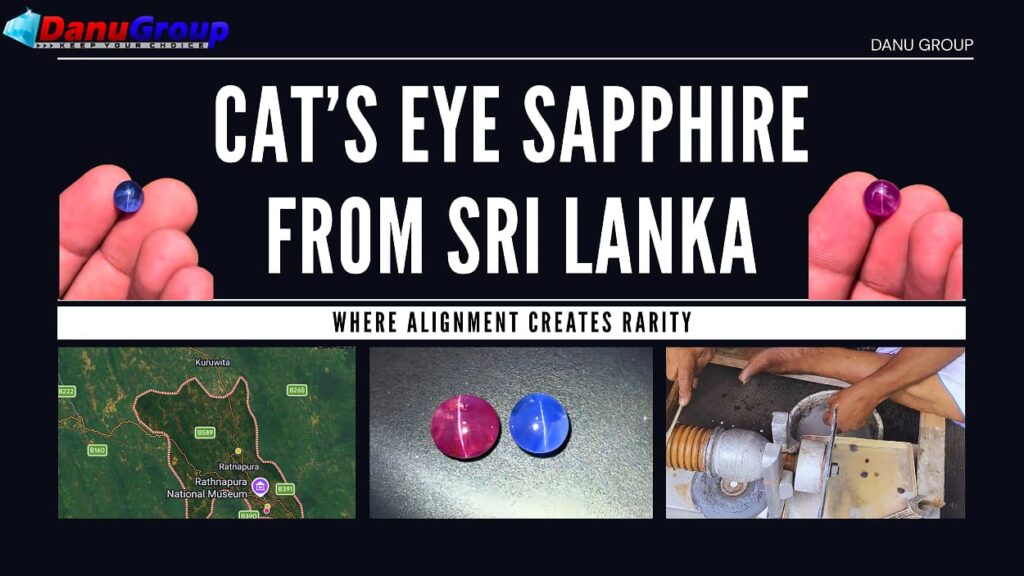
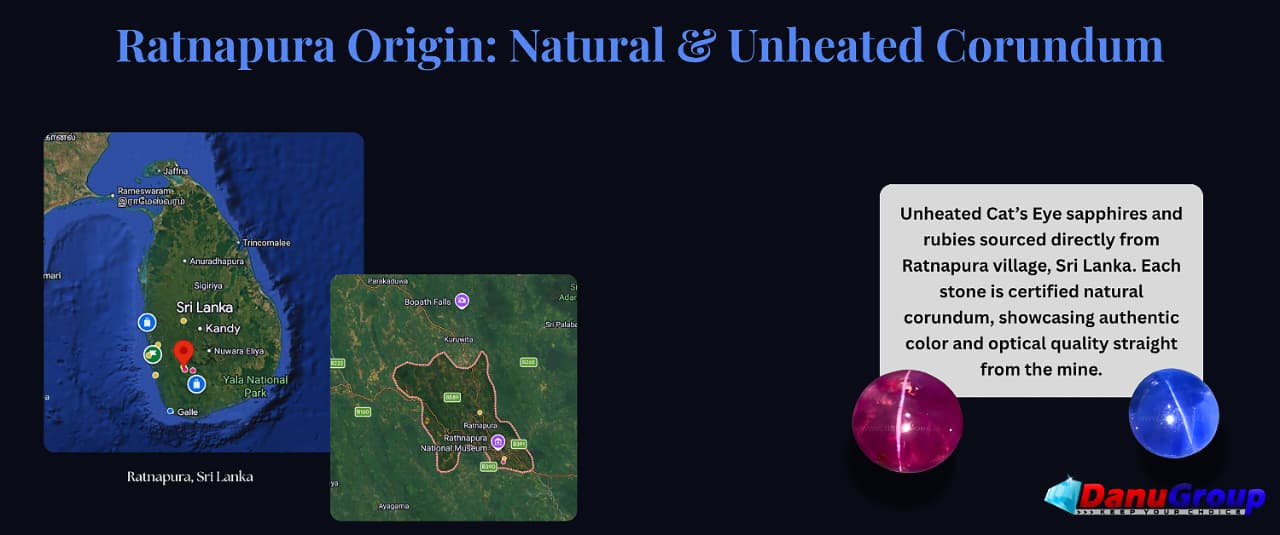
Unheated Blue (Cornflower Blue) Cat’s Eye Sapphire & Ruby Cat’s Eye — Certified Natural Corundum from Ratnapura village around mining in Sri Lanka
In fine gemstones, rarity is not defined by color alone. It is often created where natural internal structure, optical precision, and skilled cutting meet in perfect balance. Cat’s Eye in corundum belongs to that rare category.
What is Cat’s Eye in Corundum?
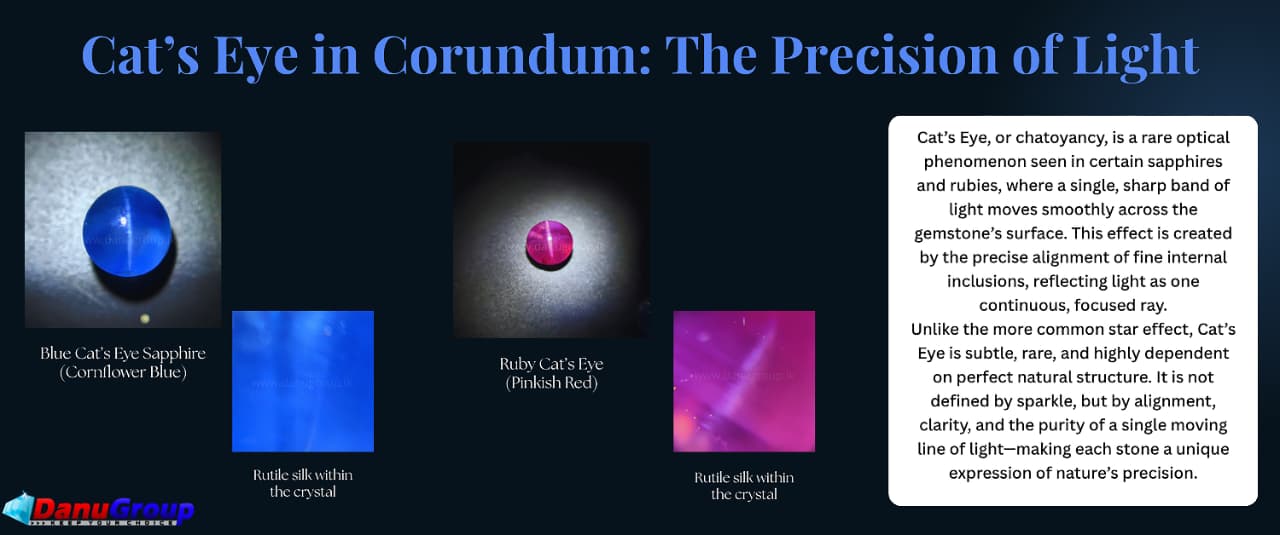
Cat’s Eye, also known as chatoyancy, is an optical phenomenon where a single, sharp band of light moves across a gemstone’s surface. In corundum — the mineral family of sapphire and ruby — this effect forms when parallel rutile silk inclusions are naturally aligned within the crystal. When light strikes that aligned structure, it reflects as one continuous ray: clean, centered, and mobile.
Unlike the more commonly seen star effect (asterism) in sapphire, which displays multiple rays, chatoyancy is much rarer and less frequently encountered in corundum. This single-eye effect is uncommon, making Cat’s Eye sapphires especially interesting to collectors, gemologists, and connoisseurs of rare optical gemstones.
Unlike brilliance in faceted stones, Cat’s Eye is not about sparkle. It is about precision alignment. If the internal structure is even slightly misaligned, the eye will break, blur, or disappear entirely.
Certified Specimens
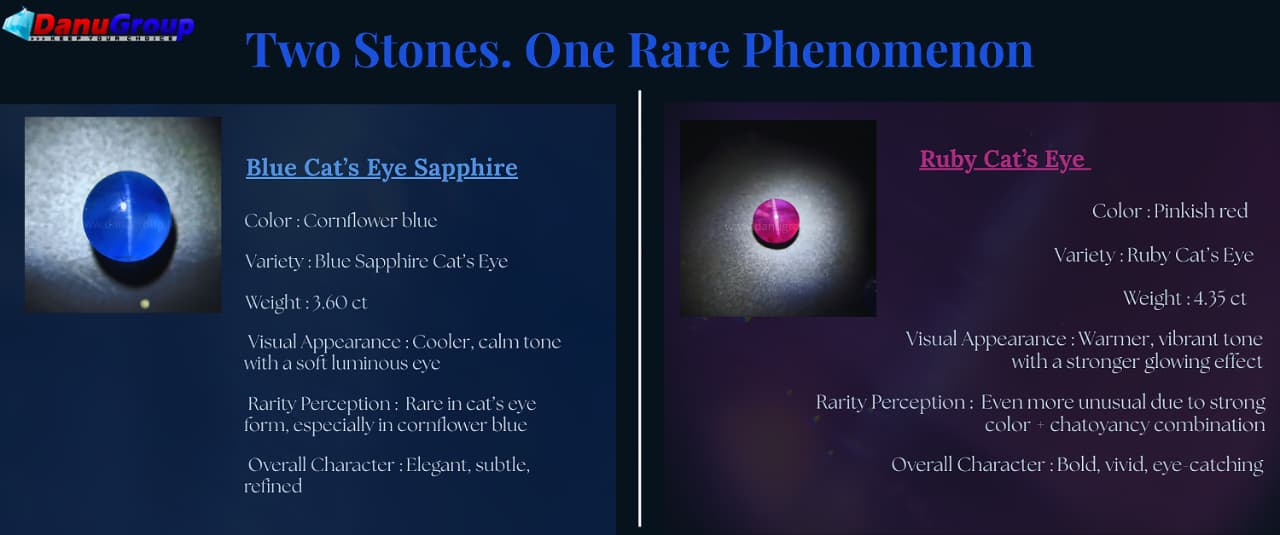
| Specification | Blue Cat’s Eye Sapphire (Cornflower Blue) | Ruby Cat’s Eye (Pinkish Red) |
|---|---|---|
| Weight | 3.60 ct | 4.35 ct |
| Dimensions | 7.93 × 7.72 × 6.54 mm | 8.82 × 8.46 × 5.92 mm |
| Cut | Oval Cabochon | Oval Cabochon |
| Color | Blue (Cornflower Blue) | Pinkish Red |
| Species | Natural Corundum | Natural Corundum |
| Variety | Blue Sapphire Cat’s Eye | Ruby Cat’s Eye |
| Treatment | No indication of heating | No indication of heating |
| Origin | Sri Lanka (Ratnapura region, village around mining in Sri Lanka) | Sri Lanka (Ratnapura region, village around mining in Sri Lanka) |
Both stones are laboratory-certified natural corundum, with no heating detected, confirming both authenticity and rarity.
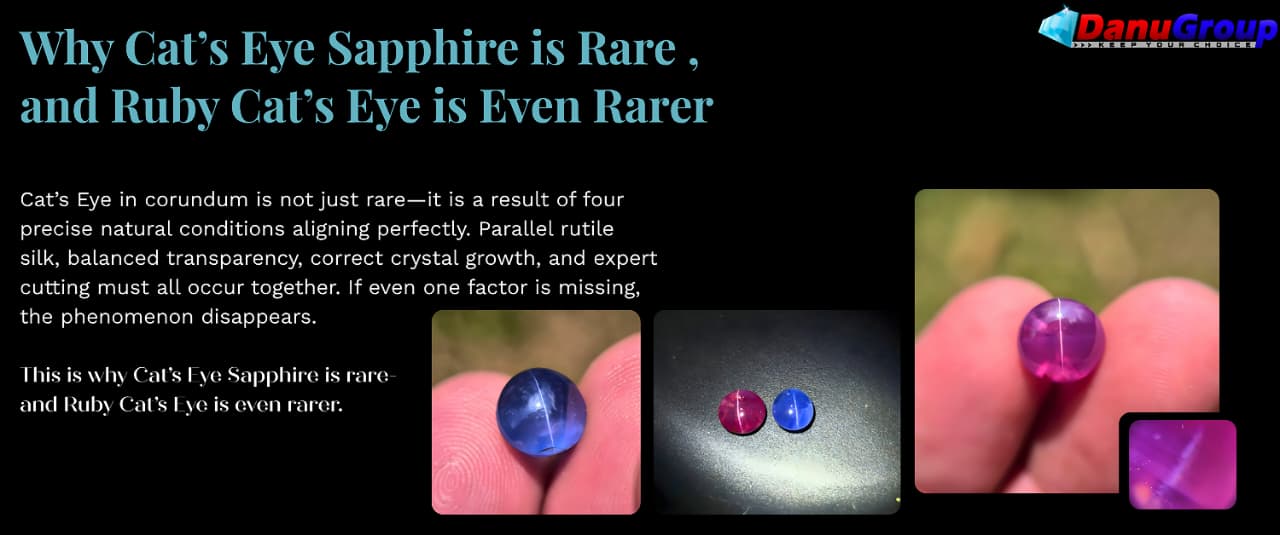
Why Cat’s Eye Sapphire is Rare — and Ruby Cat’s Eye is Even Rarer
Most people are familiar with sapphires and rubies as faceted gemstones. You can visit a gem shop or even attend a gem show and, with some effort, find blue sapphires, rubies, padparadscha sapphires, and sometimes even alexandrite. But in most cases, you will not find a fine Cat’s Eye in corundum easily.
Cat’s Eye in corundum requires four simultaneous natural conditions:
- Perfectly parallel rutile silk alignment
- Adequate transparency without destroying the silk
- Correct crystal growth direction
- Skilled orientation during cutting
If even one factor is missing, the phenomenon fails.
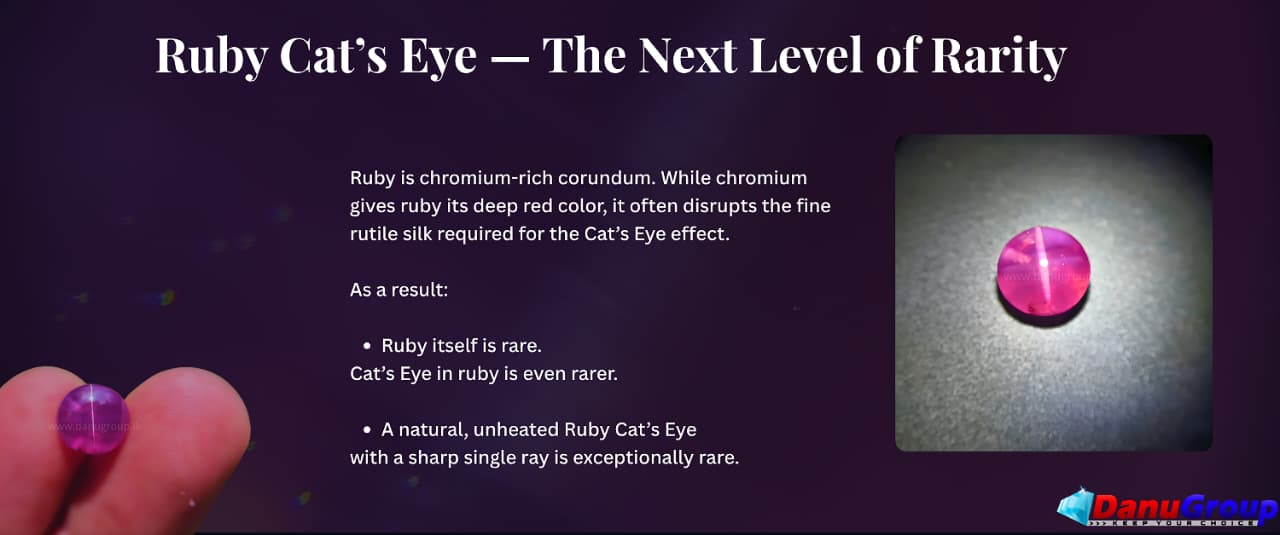
Ruby Cat’s Eye — The Next Level of Rarity
Ruby is chromium-rich corundum. Chromium strengthens red color, but it can also disrupt the uniform silk alignment needed for chatoyancy.
- Ruby itself is rarer than sapphire
- Cat’s Eye effect in ruby is rarer still
- A natural, unheated Ruby Cat’s Eye with a strong single ray is exceptionally rare
Ruby Cat’s Eye = Collector-level rare
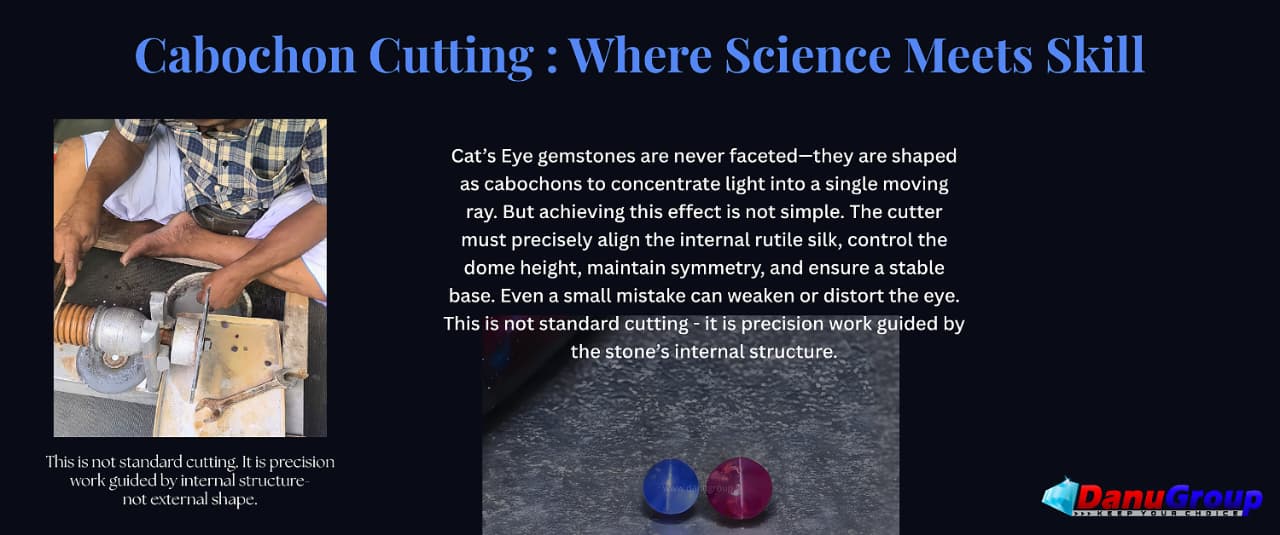 Cabochon Cutting: Where Science Meets Skill
Cat’s Eye stones are always cut as cabochons, not faceted. The dome shape concentrates light into a single ray.
Successful cutting requires:
- Exact orientation of internal silk
- Correct dome height (too flat = weak eye, too high = distorted eye)
- Symmetry to keep the eye centered
- Stable base alignment for movement consistency
This is not standard cutting. It is precision work guided by internal structure, not external shape.
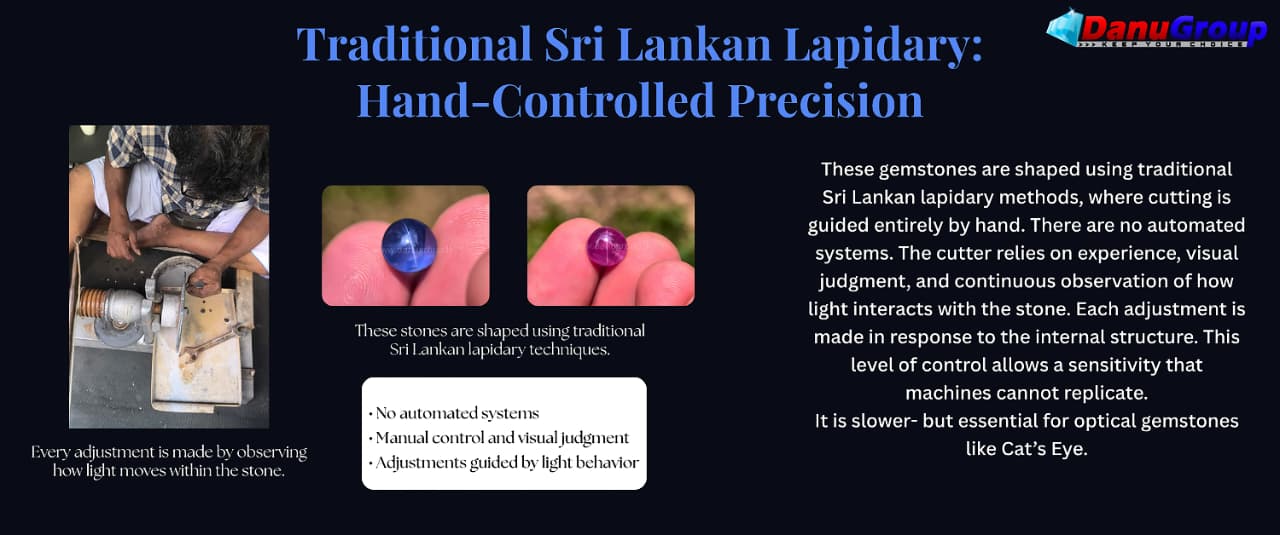
Traditional Sri Lankan Lapidary: Hand-Controlled Precision
These stones are cut using traditional Sri Lankan lapidary methods, where:
- No automated systems are used
- The cutter relies on manual control and visual judgment
- Each adjustment is made under direct observation of light behavior
This method allows sensitivity to internal alignment that modern machines cannot replicate. It is slower — but essential for optical stones such as Cat’s Eye.
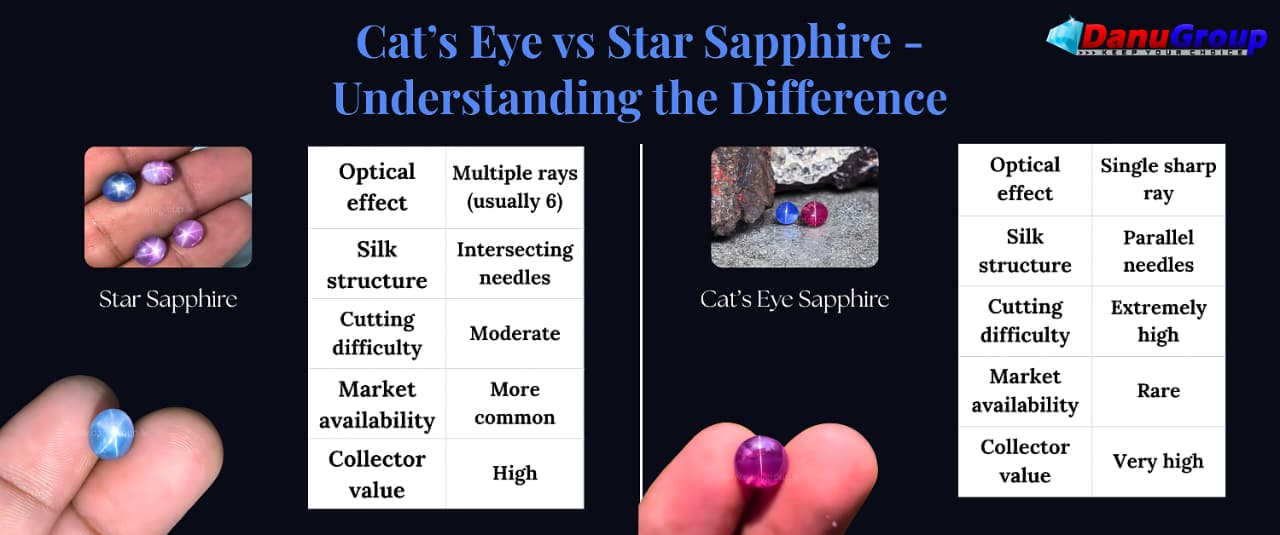
Cat’s Eye vs Star Sapphire — Understanding the Difference
| Feature | Star Sapphire | Cat’s Eye Sapphire |
|---|---|---|
| Optical effect | Multiple rays (usually 6) | Single sharp ray |
| Silk structure | Intersecting needles | Parallel needles |
| Cutting difficulty | Moderate | Extremely high |
| Market availability | More common | Rare |
| Collector value | High | Very high |
Producing one perfect ray is often harder than producing multiple rays. That is why Cat’s Eye stones are respected at a deeper level among professionals.
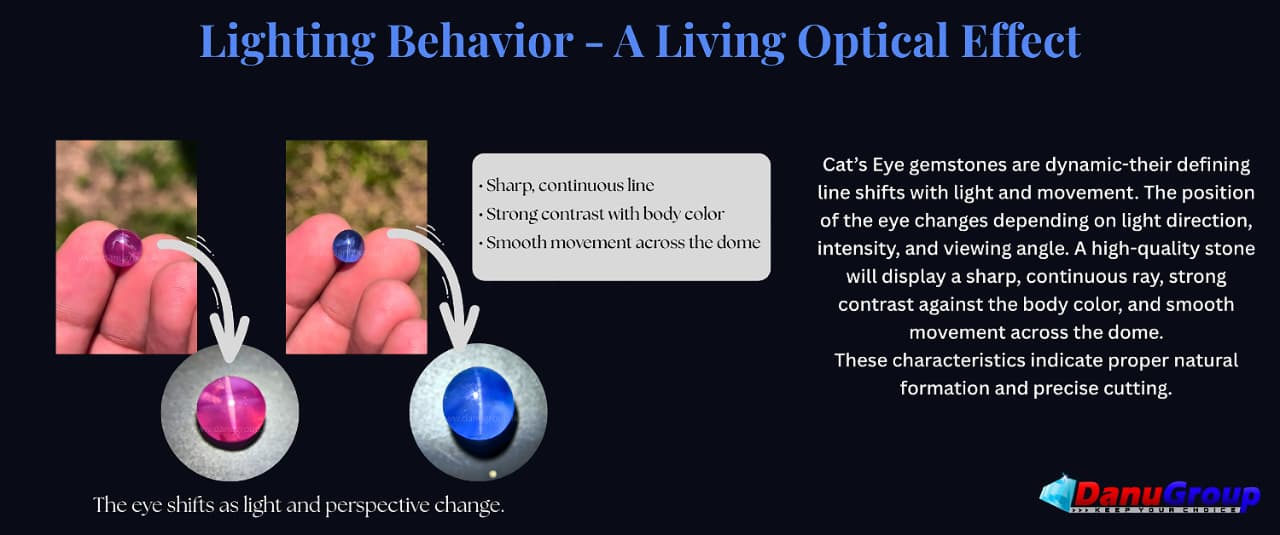
Lighting Behavior — A Living Optical Effect
Cat’s Eye gemstones are dynamic. The eye moves depending on:
- Light direction
- Light intensity
- Viewing angle
A high-quality Cat’s Eye should show:
- A sharp, continuous line
- Strong contrast with body color
- Smooth movement across the dome
Both stones presented here demonstrate this behavior clearly — an indicator of correct natural structure and expert cutting.
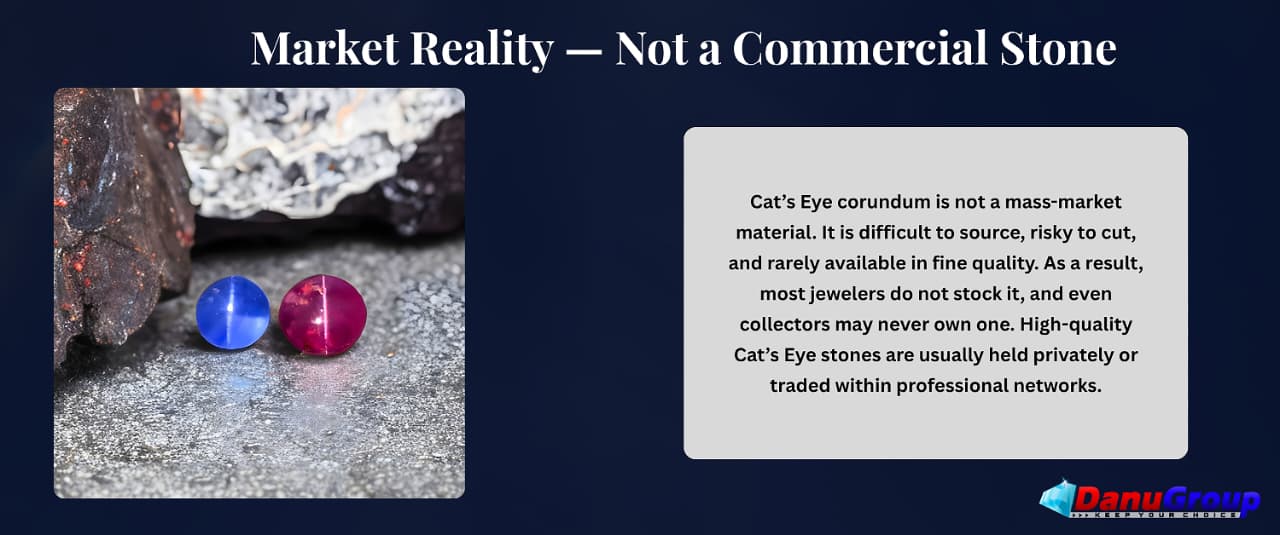
Market Reality — Not a Commercial Stone
Cat’s Eye corundum is not mass-market material. It is:
- Difficult to source
- Risky to cut
- Rarely available in fine quality
That is why:
- Most jewelers do not stock it
- Even collectors may never own one
- High-quality pieces are usually held privately or traded within professional networks
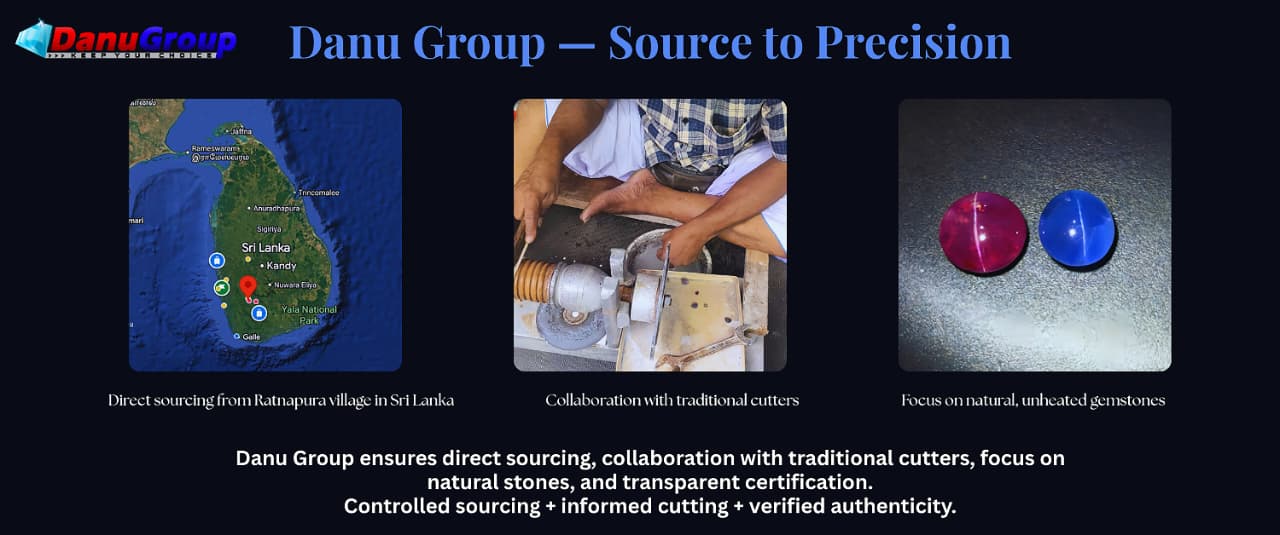
Danu Group — Source to Precision
At Danu Group, these stones represent:
- Direct sourcing from Ratnapura village around mining in Sri Lanka
- Collaboration with traditional cutters
- Focus on natural, unheated gemstones
- Transparent documentation through independent certification
This is not just supply — it is controlled sourcing + informed cutting + verified authenticity.
Final Perspective
You can find sapphire.
You can find ruby.
You can even find rare stones with effort.
But when you ask for:
- A true Cat’s Eye Sapphire
- A natural Ruby Cat’s Eye
- Unheated, correctly cut, with a sharp single ray
That is where rarity begins.
It is revealed only when nature has already aligned everything perfectly.
Frequently Asked Questions
1. What is a Cat’s Eye sapphire?
A Cat’s Eye sapphire is a corundum gemstone that shows a single moving band of light caused by parallel internal inclusions (chatoyancy).
2. Is Ruby Cat’s Eye rarer than Sapphire Cat’s Eye?
Yes. Ruby Cat’s Eye is significantly rarer due to the difficulty of achieving proper internal alignment in chromium-rich corundum.
3. Are these stones treated?
No. Both stones show no indication of heating, confirmed by laboratory certification.
4. Why are Cat’s Eye stones cut as cabochons?
Cabochon cuts allow light to concentrate into a single ray. Faceting would scatter light and destroy the effect.
5. Can I easily find Cat’s Eye sapphire in the market?
No. Even in major gem markets, high-quality Cat’s Eye sapphire or ruby is rarely available.
6. What determines a high-quality Cat’s Eye?
A sharp, centered, continuous eye with strong contrast and smooth movement.
7. Why are these stones important for collectors?
They represent a combination of natural rarity, optical precision, and traditional craftsmanship—making them highly desirable for advanced collectors.