
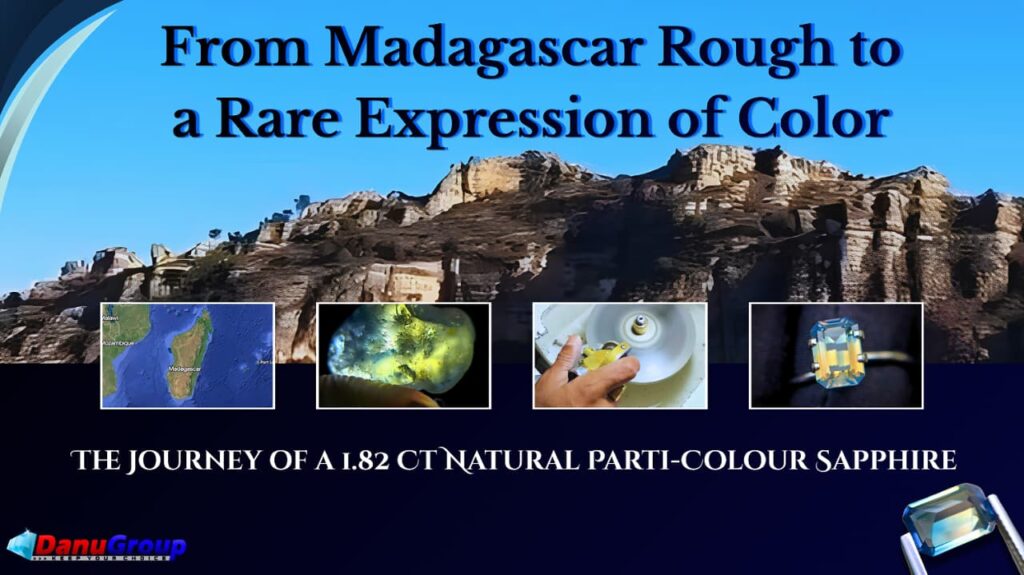
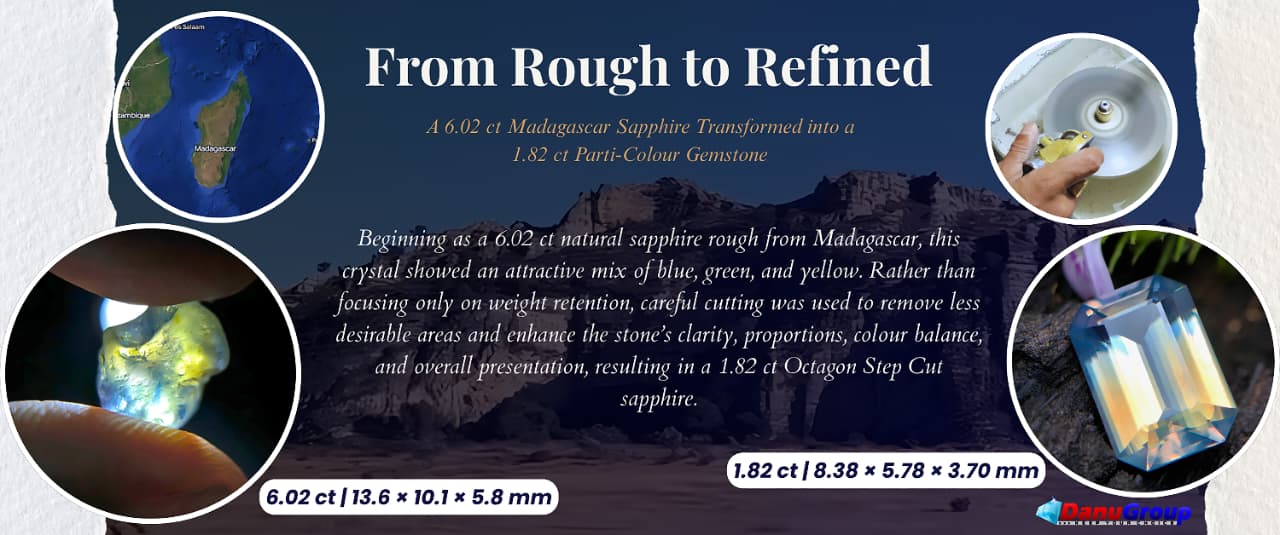
This 1.82 ct Natural Parti-Colour Sapphire began its journey as a 6.02 ct natural sapphire rough from Madagascar, measuring approximately 13.6 × 10.1 × 5.8 mm. Even in its rough state, the crystal displayed an attractive natural mixture of blue, green and yellow, giving an early indication of the multi-color character that could be revealed through careful cutting.
The rough had enough usable volume to potentially produce a finished gemstone of more than 3 carats. However, at Danu Group, maximum weight retention is not always the final objective. During evaluation, the rough was studied for its internal clarity, natural color zoning, structural characteristics, likely cutting orientation, and the balance that could be achieved in the finished stone.
Rather than preserve additional weight and leave less desirable areas within the gemstone, we chose to remove more material and focus on the cleaner, better-positioned section of the crystal. This decision reduced the final weight substantially, but it allowed us to create a more refined gemstone with stronger clarity, better proportions, a more balanced outline, and a cleaner presentation of its natural colors.
The finished result is a 1.82 ct blue-green-yellow Parti-Colour Sapphire, measuring 8.38 × 5.78 × 3.70 mm, fashioned into an elegant Octagon Step Cut.
From Rough Sapphire to Finished Gemstone
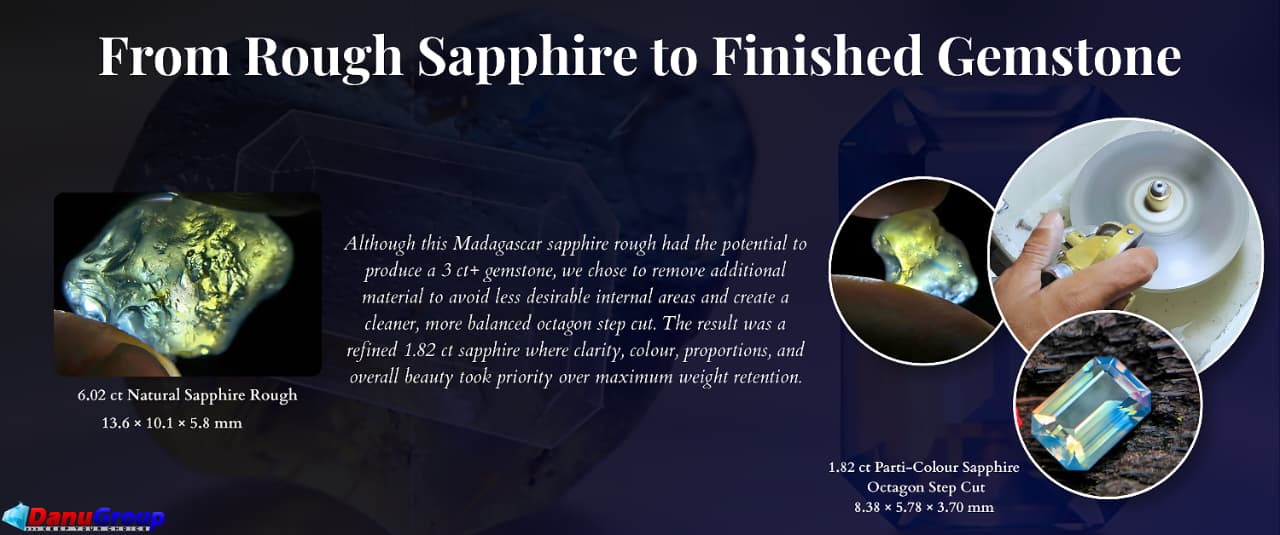
Cutting natural gemstone rough is always a balance between what the crystal can offer and what the cutter chooses to prioritize. In many cases, retaining more carat weight can mean keeping inclusions, unnecessary depth, uneven proportions, or weaker parts of the rough.
For this Madagascar sapphire, we deliberately chose quality over maximum recovery.
Although a 3 ct+ finished gemstone was possible, the cutting plan focused on producing a cleaner and more visually balanced stone. Additional material was removed to avoid less desirable internal areas and to create the proportions required for a well-structured octagon step cut.
This is an important part of the Danu Group approach: losing weight during cutting is acceptable when the final result becomes significantly better.
From sourcing the original rough, studying the crystal, planning the cut, removing unnecessary material, faceting, polishing, photography, and certification, the entire gemstone journey has remained connected to Danu Group.
What Is a Parti-Colour Sapphire?
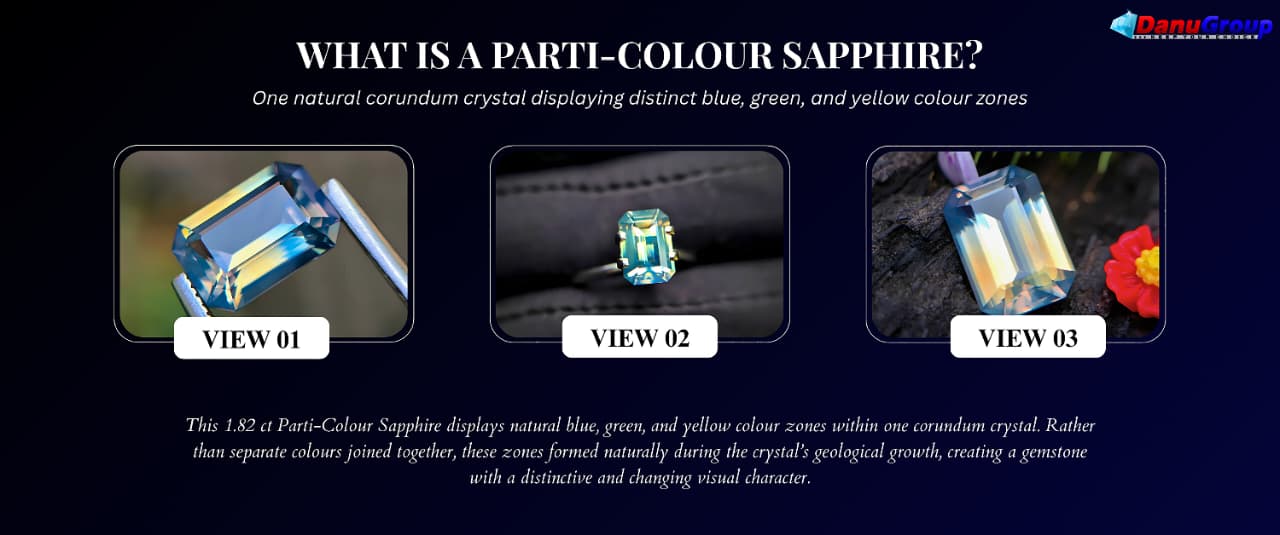
A Parti Sapphire, also known as a parti-colour sapphire, is a natural sapphire displaying two or more distinct colors within the same crystal.
In this gemstone, the visible combination includes blue, green and yellow. These are not separate gemstones joined together. They are natural color zones formed within one corundum crystal during its geological growth.
Parti sapphires can show very different appearances depending on the direction of viewing and the lighting environment. In one position, blue or bluish-green may dominate. In another, the yellow regions can become more visible. The relationship between these colors gives the stone a constantly changing visual character.
Gemological Science of Sapphire
Sapphire belongs to the mineral species corundum, whose chemical composition is aluminum oxide, Al₂O₃.
Pure corundum is essentially colorless. The wide range of sapphire colors develops because small quantities of trace elements enter the crystal structure while the mineral is forming.
In blue sapphire, iron and titanium are especially important. Interactions between these elements can produce the absorption responsible for blue coloration. Yellow sapphire is commonly influenced by ferric iron, while green sapphire can develop when blue- and yellow-producing absorption characteristics overlap or when iron-related chemistry creates greenish tones.
Because these trace elements are not always distributed evenly while a sapphire crystal grows, one part of the crystal may develop blue color while another appears yellow or green. This natural variation is one of the main geological reasons parti-colour sapphires exist.
These chemical explanations are general scientific properties of sapphire and should not be confused with individual laboratory testing of this particular gemstone.
Physical and Optical Properties of Corundum
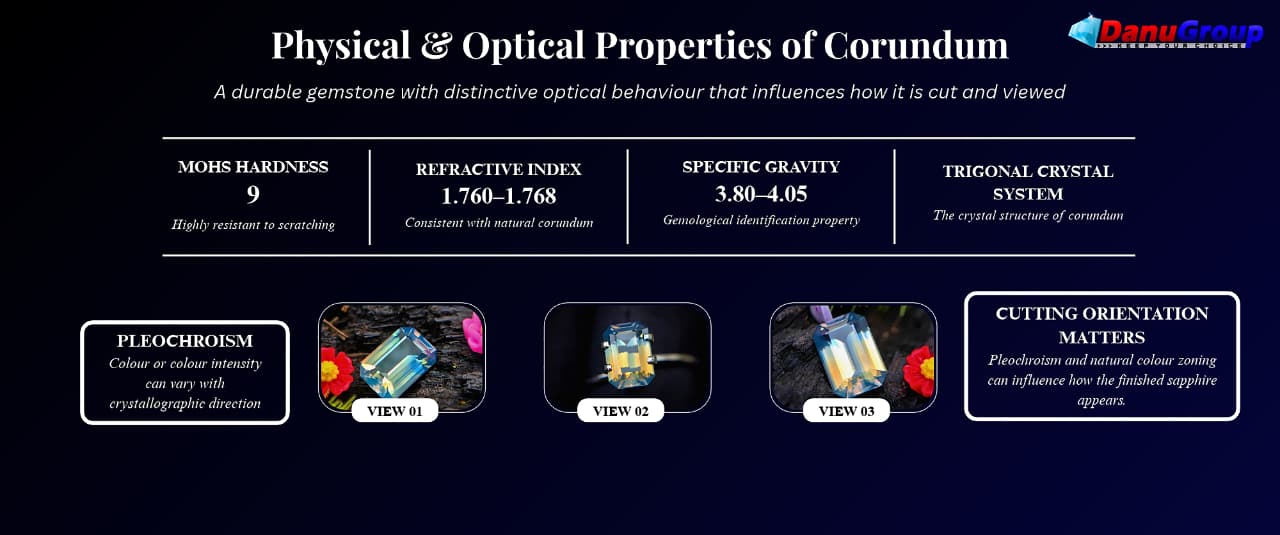
Corundum crystallizes in the trigonal crystal system and is one of the most durable natural gemstone minerals.
Sapphire has a hardness of 9 on the Mohs scale, making it highly resistant to scratching and especially suitable for rings and other jewelry designed for regular wear.
The supplied gemological information for this individual stone records a refractive index of 1.760–1.768, which is consistent with natural corundum. Its specific gravity is given as 3.80–4.05, and the stone shows distinct pleochroism.
Pleochroism means that different crystallographic directions can show variations in color or color intensity. In a parti-colour sapphire, this optical effect can work together with natural color zoning, making orientation especially important during cutting.
Why the Octagon Step Cut Was Chosen
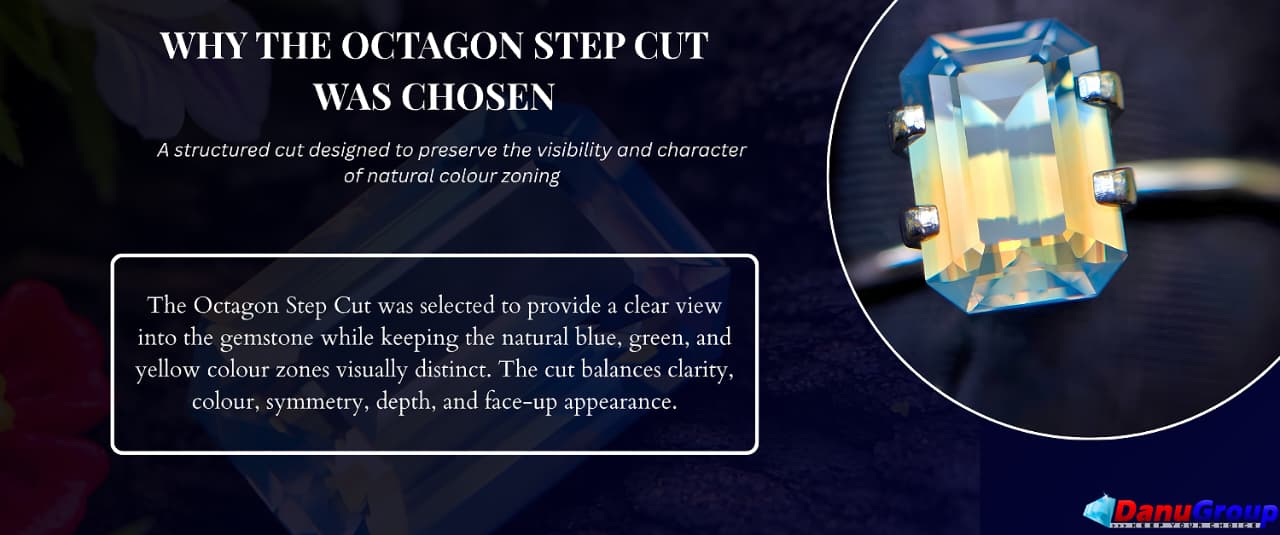
The Octagon Step Cut is particularly effective for a gemstone with natural color zoning.
Step cuts use broad, parallel facets rather than a large number of smaller brilliant-style facets. This gives the viewer a clearer look into the body of the gemstone and allows the blue, green, and yellow zones to remain visually distinct.
For this sapphire, the cut was planned to achieve a balance between clarity, color, symmetry, depth, and face-up appearance.
The elongated octagonal outline also gives the stone a refined architectural character and makes it suitable for contemporary rings, pendants, or bespoke fine-jewelry designs.
Natural Unheated Sapphire
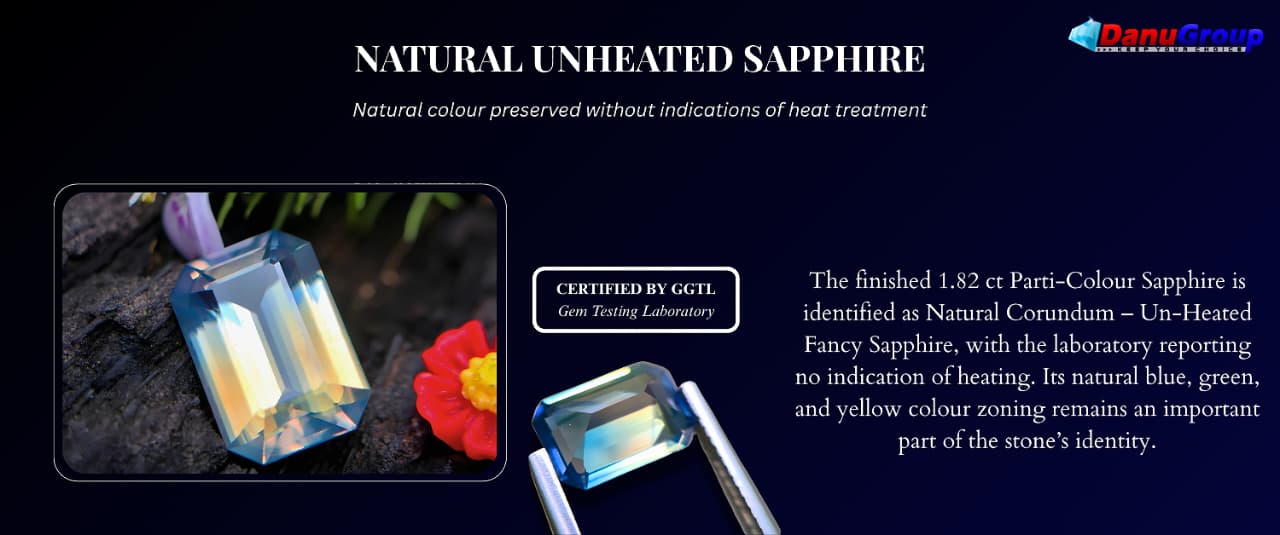
The gemstone is described as Natural Corundum – Un-Heated Fancy Sapphire, with the laboratory comment “No Indication of Heating.”
Heat treatment is widely used in the international sapphire market to improve or modify color and sometimes apparent clarity. Heated and unheated sapphires are both natural gemstones, provided the treatment history is disclosed accurately.
In this case, the supplied laboratory examination found no indication of heating, making the natural color distribution an important part of the gemstone’s identity.
The accompanying GGTL certificate also notes that sapphires that have not been enhanced by heat are scarce.
Certified Natural Parti Sapphire
The finished gemstone is accompanied by a GGTL – Gem Testing Laboratory certificate.
A Danu Group Source-to-Finished Journey
This gemstone represents more than its final carat weight.
The journey began with a 6.02 ct Madagascar rough sapphire, naturally showing blue, green, and yellow. Although the rough offered the possibility of a significantly heavier finished stone, we chose to sacrifice weight in favor of better clarity, stronger proportions, improved visual balance, and a more refined octagon step cut.
For Danu Group, the goal is not simply to produce the largest stone possible from a rough crystal. The objective is to reveal the strongest version of that gemstone while maintaining accurate treatment disclosure, responsible cutting decisions, and a clear connection between source and final presentation.
This 1.82 ct Natural Parti-Colour Sapphire is the result of that philosophy—source authenticity, gemological understanding, precision craftsmanship, and quality-first cutting from rough to finished stone.
FAQ
1. What is a parti-colour sapphire?
A parti-colour sapphire is one natural sapphire crystal containing two or more visibly different color zones.
2. What did this sapphire weigh before cutting?
The original Madagascar rough weighed 6.02 ct and measured approximately 13.6 × 10.1 × 5.8 mm.
3. Why was the finished weight reduced to 1.82 ct?
The rough could potentially have produced a stone above 3 ct, but more material was intentionally removed to prioritize clarity, proportions, balance, and overall finished quality.
4. What causes the blue, green and yellow colors?
Different trace elements and their distribution during crystal growth influence sapphire color. Iron and titanium are important in blue sapphire, while iron-related chemistry contributes to yellow and many green tones.
5. Has this sapphire been heat treated?
The supplied laboratory report states No Indication of Heating.
6. What is sapphire made of?
Sapphire is corundum, a crystalline aluminum oxide mineral with the chemical formula Al₂O₃.
7. Why is sapphire suitable for jewelry?
Corundum has a Mohs hardness of 9, giving sapphire excellent scratch resistance and making it suitable for rings, pendants, earrings, and other fine jewelry.
8. Why choose an octagon step cut for a parti sapphire?
The broad step facets help reveal the gemstone’s natural color zoning while creating a clean, balanced, geometric appearance.