
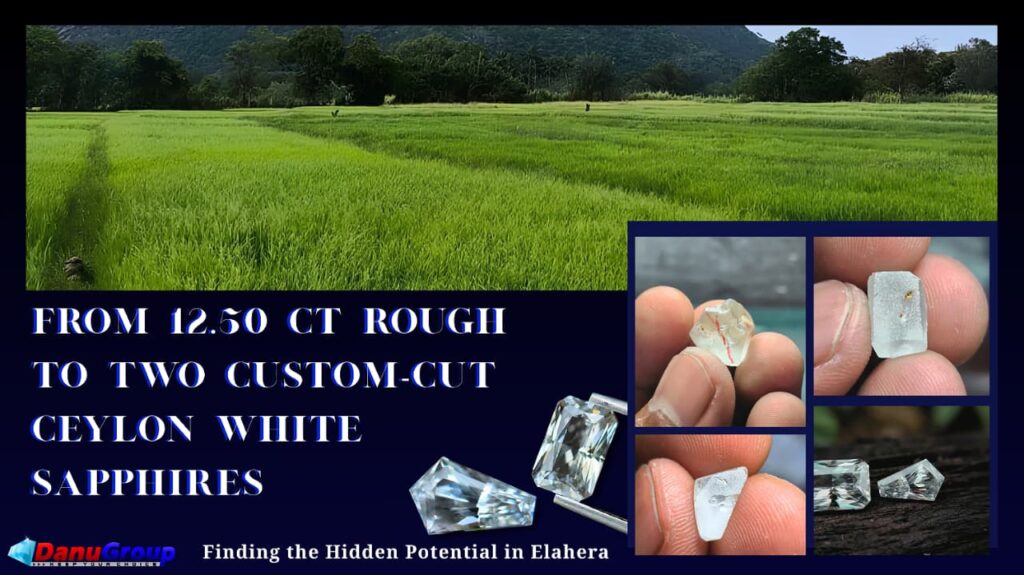
A rough gemstone does not need to look perfect to hold excellent potential. Sometimes the most interesting cutting journeys begin with fractures, inclusions and an irregular crystal shape.
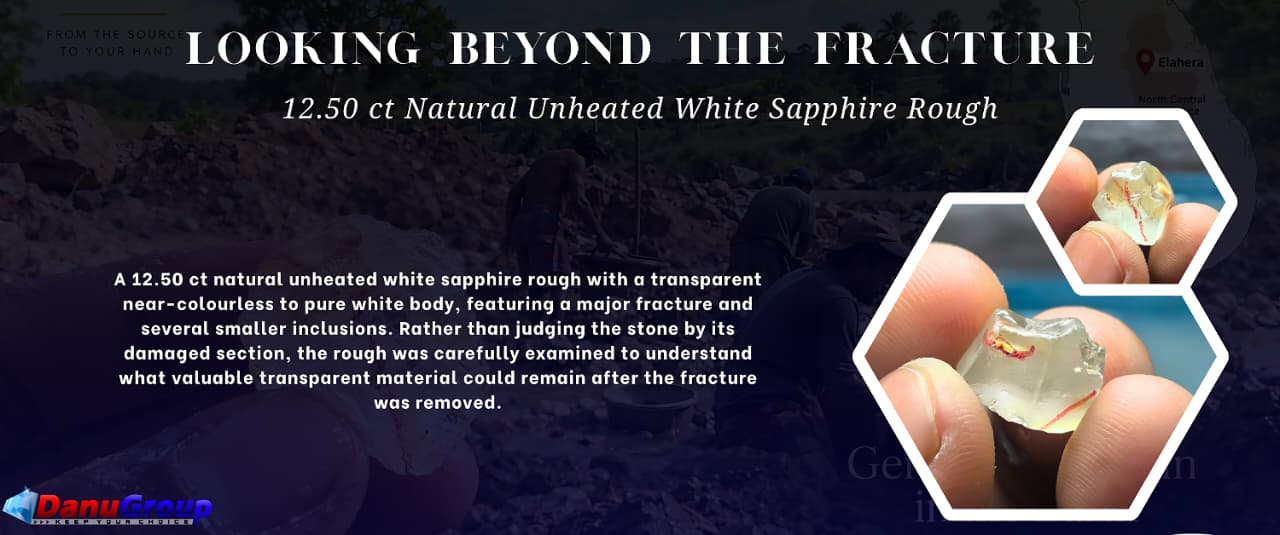
This 12.50 ct natural unheated white sapphire rough was sourced from the Elahera gem-producing area in Sri Lanka’s North Central Province during one of our Danu Group gem-hunting journeys. What began as a fractured piece of rough eventually became two completely different finished gemstones: a 3.00 ct rectangular radiant-cut white sapphire and a 1.25 ct custom asymmetrical shield-style geometric sapphire.
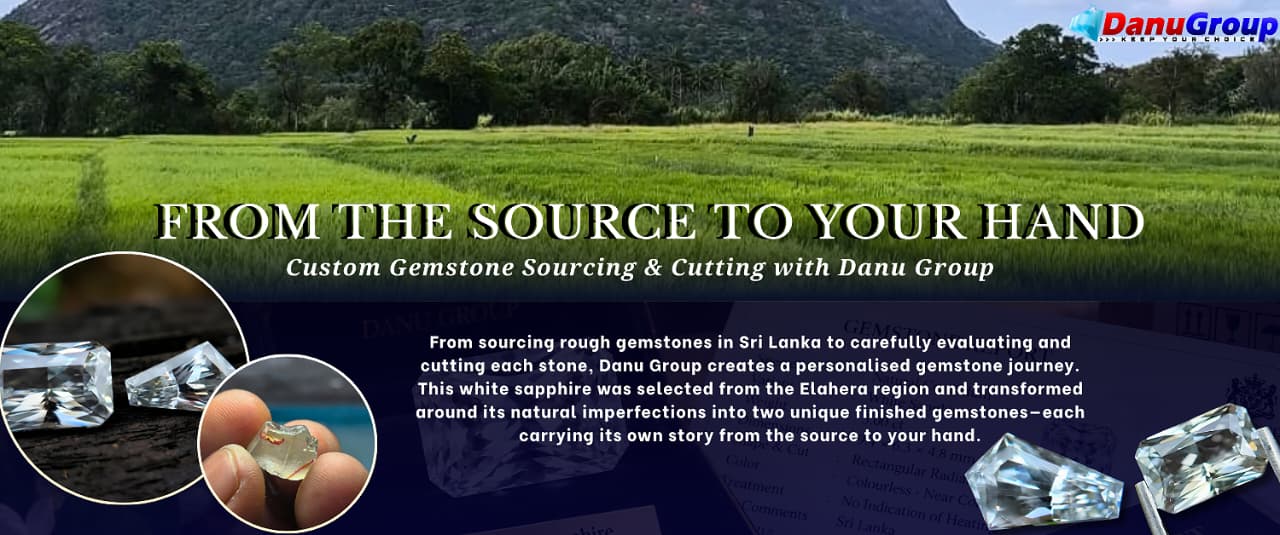
More importantly, this journey demonstrates an important part of gemstone sourcing and cutting: it is not simply about the original size of the rough. It is about recognizing the hidden potential inside it.
Direct Gemstone Sourcing from Sri Lankan Source Areas
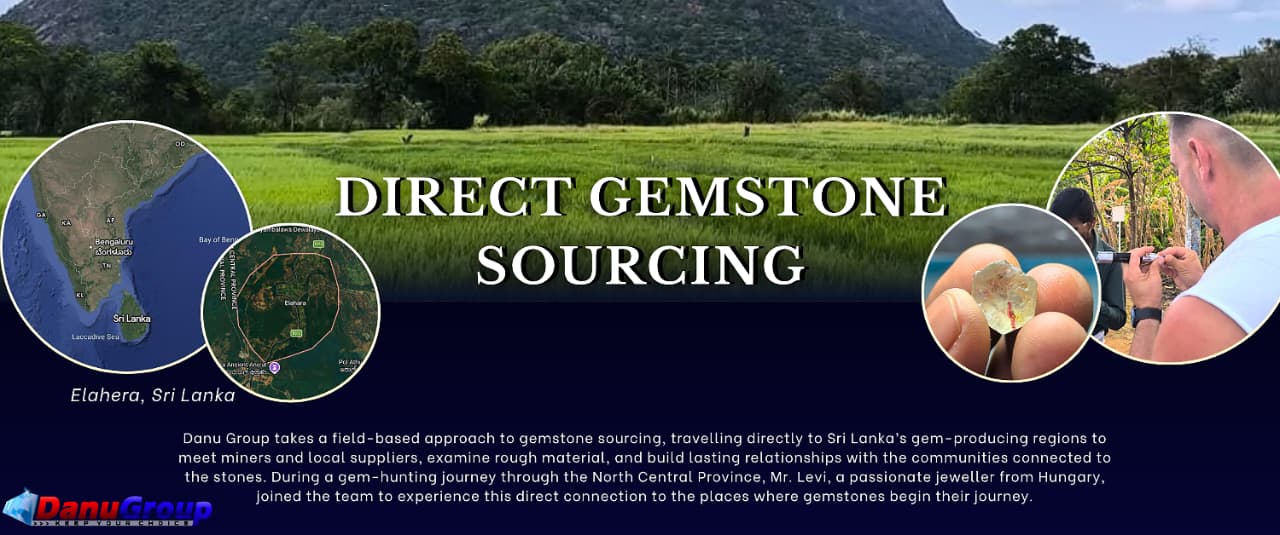
Danu Group’s approach to gemstone sourcing is field-based.
We do not simply sit in an office waiting for gemstones to pass through the market. We travel through Sri Lanka’s gemstone-producing regions, visit source areas, meet miners and local suppliers, examine rough material and build long-term relationships with the communities connected to the stones.
On this particular gem-hunting trip through the North Central Province, Mr. Levi, a passionate jeweller from Hungary, joined us.
For us, this is one of the most rewarding parts of the gemstone business. Sometimes we are examining gemstones at a table; sometimes we are travelling through villages, visiting mining areas and quite literally stepping into the mud. That direct connection gives a completely different understanding of where a gemstone begins its journey.
A 12.50 ct White Sapphire with a Major Fracture
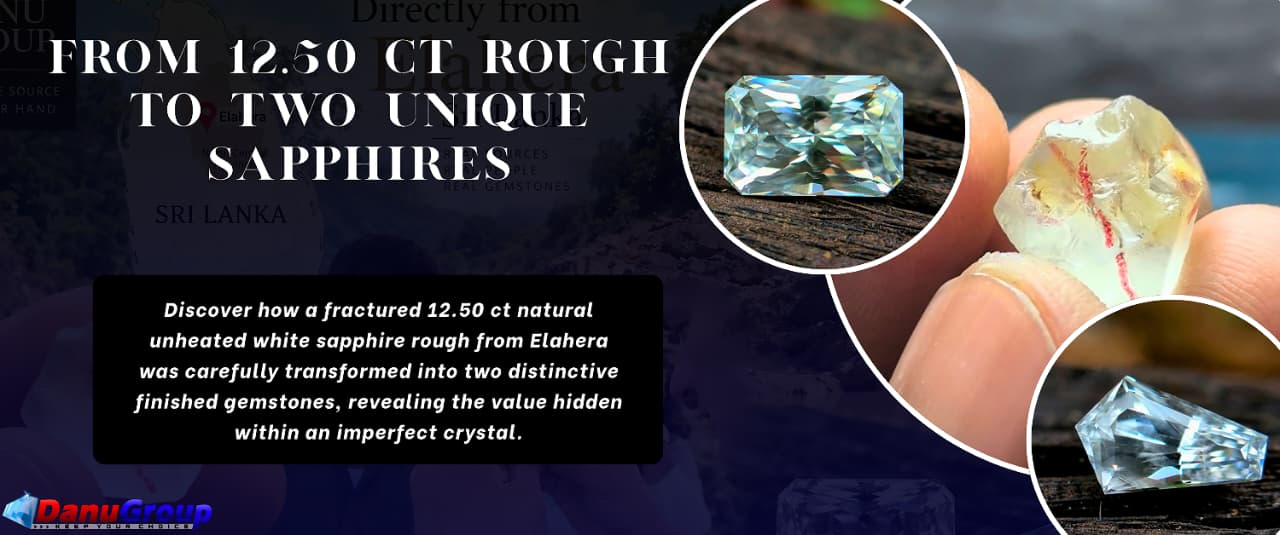
When we first examined this rough sapphire, the potential was not immediately obvious.
The stone had an attractive near-colourless to pure white transparent body, but a strong fracture ran through part of the rough, with several smaller inclusions around it.
Because the overall crystal body was comparatively large and transparent, we did not judge the stone only by the damaged section. Instead, we studied what might remain after the major fracture was removed.
This is an important principle when evaluating facet-grade rough.
A 12ct rough stone does not automatically mean a large finished gemstone. Equally, a fractured rough stone does not automatically mean there is nothing valuable inside it.
The real question is:
What can safely and beautifully be recovered from the usable part of the crystal?
Evaluating the Rough Before Cutting
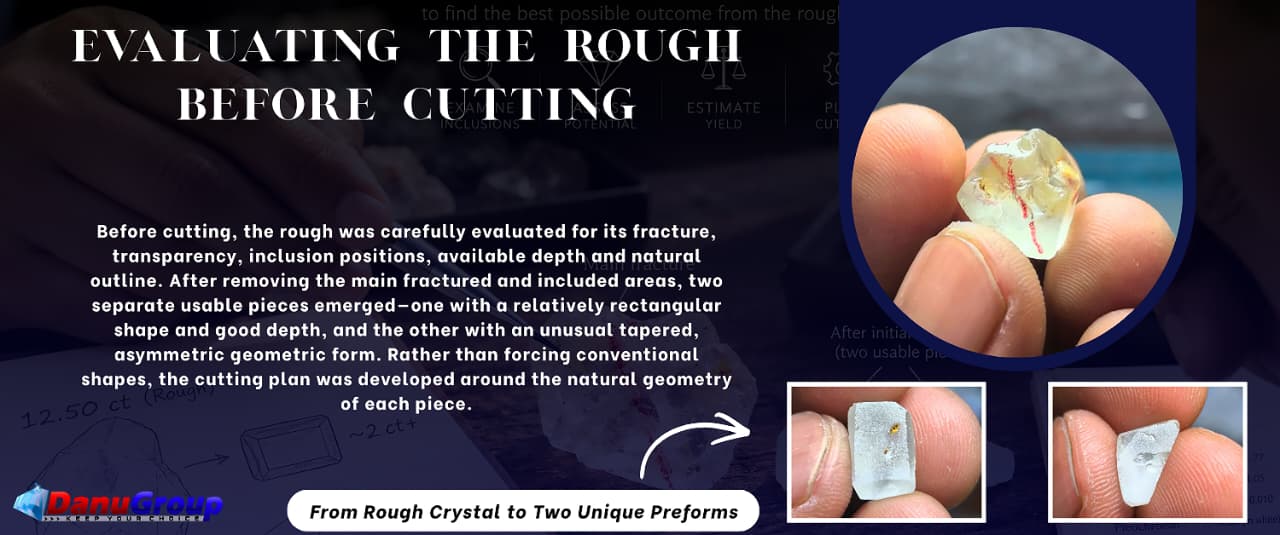
Together, we carefully examined the fracture, transparency, inclusion positions, available depth and natural outline.
Our initial estimate was that the larger clean section could potentially produce a finished gemstone of more than 2 ct, while the second section might produce approximately 1 ct.
These were estimates rather than guarantees. With natural rough gemstones, the final result can change as trimming exposes internal features that were difficult to evaluate from the surface.
After removing the main fractured and unnecessary included areas, we obtained two separate usable pieces.
And this was where the project became particularly interesting.
The two preforms looked almost unrelated.
The larger piece had a relatively rectangular outline with good depth. The second was an unusual tapered, asymmetric geometric shape.
Rather than forcing both stones into conventional shapes and sacrificing additional material, we decided to work with the natural geometry of each piece.
One Rough Sapphire, Two Completely Different Cutting Solutions
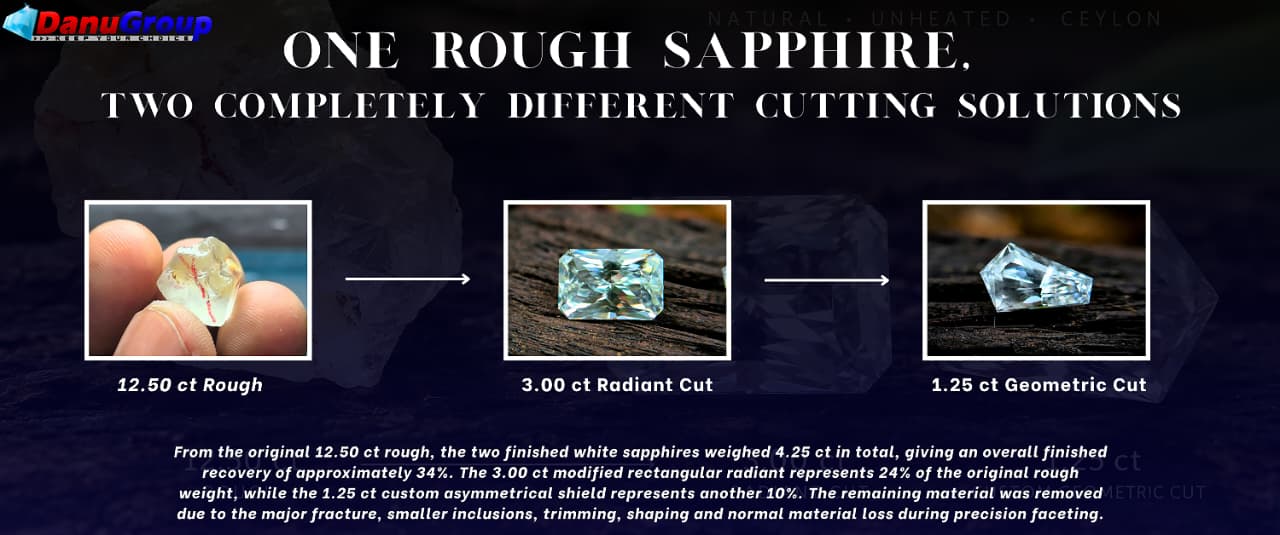
After discussing the stones with our cutter, the larger section was planned as a modified rectangular radiant cut.
Its excellent transparency and clean white appearance meant that precise faceting, symmetry and polishing could create a bright and lively finished stone.
The second piece required a completely different approach.
Its irregular outline naturally suited a custom asymmetrical shield-style geometric cut. Trying to convert it into an oval, round or perfectly rectangular stone would have required removing considerably more usable sapphire.
Instead, the cutting design followed the rough.
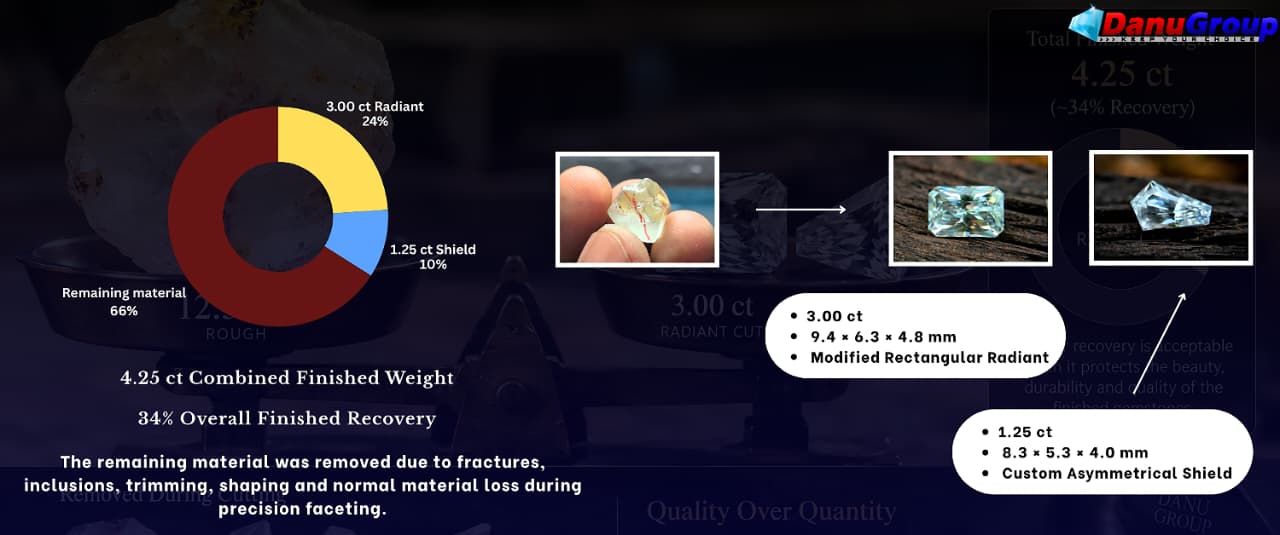
The final results were:
3.00 ct Natural Unheated Ceylon White Sapphire
Dimensions: 9.4 × 6.3 × 4.8 mm
Cut: Modified Rectangular Radiant
and
1.25 ct Natural Unheated Ceylon White Sapphire
Dimensions: 8.3 × 5.3 × 4.0 mm
Cut: Custom Asymmetrical Shield / Geometric Cut
From the original 12.50 ct rough, the combined finished weight became 4.25 ct, giving an overall finished recovery of approximately 34%.
The 3.00 ct radiant represents 24% of the original rough weight, while the 1.25 ct geometric shield represents another 10%.
The remaining material was removed because of the major fracture, smaller inclusions, trimming, shaping and the normal material loss required during precision faceting.
A 34% recovery may appear low if judged only by mathematics. But recovery percentage alone does not determine whether a cutting project is successful. Preserving damaged material simply to retain weight would have compromised the finished gemstones.
The objective was to recover the best clean, durable and visually attractive gemstones possible from the usable material.
Why Precision Cutting Matters for White Sapphire
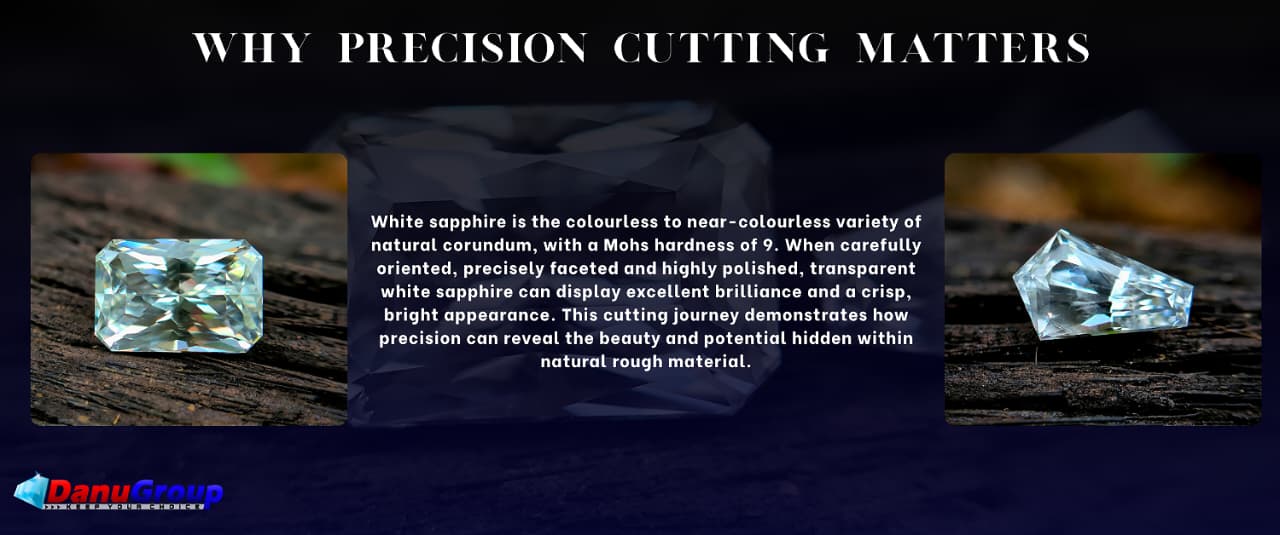
White sapphire is the colourless to near-colourless variety of natural corundum.
Corundum ranks 9 on the Mohs hardness scale, making sapphire one of the hardest natural gemstone materials commonly used in jewellery. When transparent white sapphire is carefully oriented, accurately faceted and highly polished, it can show excellent brilliance and a crisp, bright appearance.
Its optical properties are different from diamond, so the two should not be treated as identical materials. However, for customers looking for a durable natural gemstone with a clean white appearance, a well-cut natural sapphire can be an excellent and distinctive choice.
In this case, the beauty was not in the original 12.50 ct number.
The beauty was in seeing what was hidden inside it.
Custom Gemstone Sourcing and Cutting with Danu Group
This project also represents how we approach custom requirements.
A customer may be searching for a particular gemstone variety, colour, finished size, calibrated measurement, pair, unusual shape or stone designed specifically for a ring, earrings, pendant, brooch or other jewellery project.
When we understand the final purpose, we can look at rough differently.
Instead of asking only, “What standard shape can we cut from this?” we can ask:
“What is the best possible result this particular rough can produce for the customer’s purpose?”
Sometimes that result is an oval or cushion. Sometimes it is an Asscher, radiant, shield, lozenge, princess or another geometric design. And sometimes the rough itself suggests a completely individual shape.
Customers can also enquire about joining selected Danu Group gem-hunting trips in Sri Lanka, allowing them to experience part of the source journey and understand how rough gemstones are discovered, assessed and selected.
For us, gemstones are not simply products moving from one hand to another.
This white sapphire began in the Elahera source region, was selected despite its imperfections, carefully evaluated, divided around a major fracture and individually designed into two finished gemstones.
That is the difference we want a Danu Group gemstone to carry: not only a finished stone, but a journey from its source to your hand.
Danu Group — From the Source to Your Hand.
Frequently Asked Questions
1. Where was this white sapphire sourced?
The original 12.50 ct rough was sourced from the Elahera gemstone-producing area in Sri Lanka’s North Central Province.
2. Was this Ceylon white sapphire heated?
No. The rough and the resulting finished gemstones are natural unheated white sapphires.
3. Why did 12.50 ct of rough produce only 4.25 ct of finished sapphire?
A major fracture and several included areas had to be removed. Additional weight was lost during trimming, shaping and faceting. The final combined recovery was approximately 34%.
4. Why were two different cuts chosen?
After trimming, the two pieces had very different natural shapes. The larger piece suited a rectangular radiant design, while the irregular second piece was better suited to a custom asymmetrical shield-style geometric cut.
5. Can Danu Group source rough gemstones for a custom jewellery project?
Yes. Customers can provide their preferred gemstone, colour, approximate size, shape, budget and intended jewellery design. We can then look for suitable material through our source network and discuss realistic cutting possibilities.
6. Can a customer request a special gemstone cut?
Yes. Custom cutting can be considered according to the rough stone’s dimensions, inclusions, colour orientation, depth and structural condition. The objective is to achieve the customer’s requirement while protecting the beauty and integrity of the gemstone.
7. Can customers join Danu Group gemstone sourcing trips in Sri Lanka?
Selected source-area and gem-hunting trips can be discussed in advance depending on location, timing and local conditions.